Coconut Tree Prison Phu Quoc: History, What to See & Visitor Guide (2026)

Pullman Phu Quoc Beach Resort
Languages

 en
en


en
- English
- 日本語
- 한국어
- Tiếng Việt
- 简体中文
- See this hotel on all.accor.com or brand website in other languages :
Coconut Tree Prison Phu Quoc: History, What to See & Visitor Guide (2026)
Found 29 kilometres south of Duong Dong in An Thoi commune – Coconut Tree Prison, officially the Phu Quoc Prison History Museum, is a national historical relic that preserves one of Vietnam’s most confronting wartime chapters.
For any guest spending more than a couple of days on the island, it belongs on the itinerary.
Overview of Coconut Tree Prison
The name “Coconut Tree” (Cây Dừa in Vietnamese, sometimes written Cay Dua) comes from the village of the same name in An Thoi commune where the prison stands. The site is also known as Nhà tù Phú Quốc, the An Thoi POW Camp, and the Phu Quoc Prison History Museum. All four names refer to the same place.
Coconut Tree Prison is one of the most visited and talked-about historical sites in southern Vietnam. The Vietnamese government recognised it as a National Historical Relic in 1995, and the museum opened to the public in 1996.
- Address: 350 Nguyen Van Cu Street, An Thoi Ward, Phu Quoc
- Opening hours: 7 AM to 5 PM daily (no lunch closure)
- Admission: Free for all visitors
- Recommended visit duration: 1.5 to 2 hours for the main site, plus 30–45 minutes if walking to the POW Cemetery
- Parking: Free on-site parking lot and street parking available
- Accessibility: Wheelchair-accessible parking and restrooms are available
You can find it on Google Maps here: Phu Quoc Prison History Museum.
Photography is permitted in most areas. Some B2 reconstructions have signage requesting no flash. Follow posted instructions throughout.
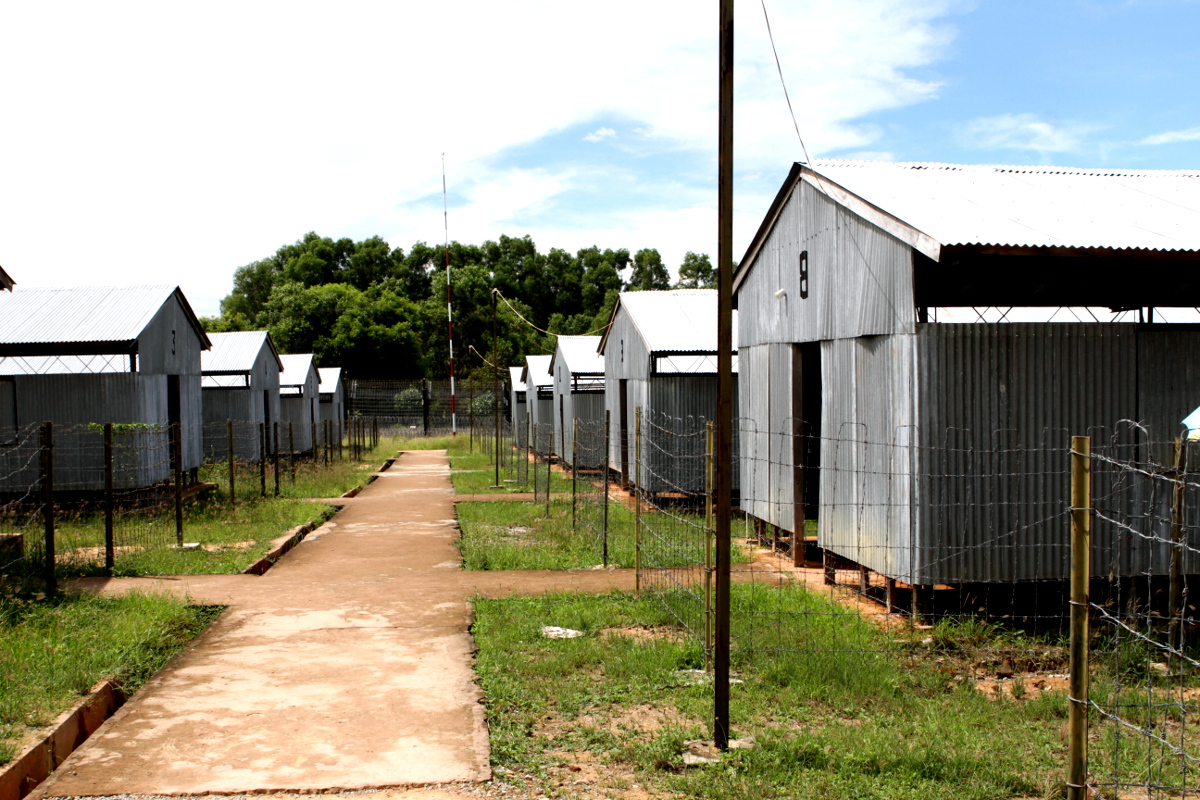
A Brief History of Phu Quoc Prison
French colonial forces built the prison between 1949 and 1950 to detain Vietnamese revolutionaries fighting against colonial rule. During the First Indochina War (1946–1954), the camp held up to 14,000 prisoners and became known for systematic brutality. After the Geneva Accords ended the conflict in 1954, most prisoners were reunited with their families and the facility temporarily fell out of use.
The Vietnam War era brought the prison back into operation in 1967, this time under the Republic of Vietnam government with American military involvement. Renamed Coconut Tree Prison and expanded to cover approximately 40 hectares, the camp became the largest prisoner-of-war facility in the south.
At its peak, it held over 40,000 revolutionary soldiers across 12 main areas, each subdivided into four sections. Torture was widespread, including tiger cage confinement, electrical shock, and other methods that are documented in the museum’s exhibition. Around 4,000 prisoners died here between 1967 and 1973. The prison closed after the Paris Peace Accords and was finally decommissioned in 1975.
The Prisoner Escapes: A Story of Extraordinary Resilience
What often goes untold is how the prisoners fought back. Inmates organised escape attempts over months, digging tunnels with metal spoons and repurposed food containers. During the 1968 Tet Offensive, a major breakout saw thousands breach the camp fences. These acts of resistance are documented in the B2 section of the museum. At the POW Cemetery, a raised-fist monument stands at the centre of a 2,000 m² circular memorial – a deliberate symbol of defiance rather than defeat.
What to See Inside Coconut Tree Prison?
The site is large and benefits from a loose plan before you arrive.
- The B2 Section is the emotional core of the visit. Life-sized reconstructions show tiger cages, solitary confinement cells, and interrogation rooms using mannequins. The detail is unsparing and intentional. Google reviewers frequently describe the experience as “confronting,” “haunting,” and “essential.” It is not recommended for children under 12.
- The Exhibition House holds two rooms. The first covers the development of the prison through artefacts and informational panels, with English-language boards throughout. The second contains over 100 photographs and documents showing how prisoners were treated and how they organised resistance.
- The POW Cemetery sits roughly 1 kilometre from the main site. The 2,000 m² grounds feature the raised-fist monument and offer a quieter, more contemplative space than the reconstruction areas. It warrants a separate short walk or ride.
- The Kien Van Church Ruins are now only concrete foundations, but they represent a place where prisoners gathered in secret. The Martyrs’ Monument at Sim Hill is less visited and offers elevated views across the southern part of the island – a worthwhile detour for those with extra time.
- The Gate of the 8th Military Police Battalion, the original entrance, sets the tone for the entire visit and orients you to the camp’s scale before you move inside.
Practical Tips for a Respectful and Rewarding Visit
Dress modestly: cover shoulders and knees. This is a national memorial, and the dress standard applies regardless of the outdoor heat. Light linen trousers and a short-sleeved shirt with coverage are practical and appropriate.
Prepare for what you will see. The B2 reconstructions were built to document atrocity, not to sanitise it. Many visitors describe the experience as genuinely distressing. Morning visits, when the site is quieter, give more space for reflection. Arriving just after 7 AM on a weekday means the fewest other visitors.
Combine the visit with Sao Beach or An Thoi Port to balance the emotional weight of the morning with the island’s natural beauty in the afternoon. Local guides who specialise in the southern circuit can be arranged through the resort concierge and add significant depth to both the historical and coastal parts of the day.
How to Get to Phu Quoc Prison from Pullman Phu Quoc?
Pullman Phu Quoc Beach Resort sits on Bãi Trường (Long Beach) in the north of the island, which places Coconut Tree Prison approximately 35 to 40 kilometres away by road – around a 45-minute drive.
The most practical route heads south from the resort onto Tran Hung Dao Street, continues to DT46, and follows Nguyen Van Cu Street directly to the prison entrance. Grab (Southeast Asia’s equivalent of Uber) is reliable for this journey and offers the most straightforward option for guests who prefer not to hire a motorbike.
The resort concierge can also assist with arranging a private car or taxi for guests who want to combine the prison with other southern attractions.
Conclusion
Coconut Tree Prison will not be the lightest few hours of your time on Phu Quoc. But it is among the most meaningful. The reconstructions, the documents, the POW Cemetery’s raised fist – together they tell the story of people who refused to break, on an island the world now visits for its sunsets and seafood.
Explore our rooms and suites at Pullman Phu Quoc and discover more of Phu Quoc’s history and attractions. Book direct for the best rate.

Frequently Asked Questions
Is Coconut Tree Prison the same as Phu Quoc Prison?
Yes. Coconut Tree Prison, Nhà tù Phú Quốc, and Phu Quoc Prison History Museum all refer to the same site at 350 Nguyen Van Cu Street in An Thoi. The “Coconut Tree” name dates to the First Indochina War, when the prison was located in Cay Dua Village. The official museum name has been in use since 1996.
Is there an entrance fee for Coconut Tree Prison?
Entry is free for all visitors regardless of nationality. Optional on-site guides and audio guides are available for approximately VND 100,000–200,000. No advance booking is required – walk-in visitors are welcome.
How long does a visit to Coconut Tree Prison take?
Most visitors spend 1.5 to 2 hours at the main site, covering the B2 reconstruction area, Exhibition House, and the original entrance. If you plan to walk to the POW Cemetery (about 1 kilometre away), add another 30 to 45 minutes.
Is Coconut Tree Prison suitable for children?
The B2 section features realistic life-sized reconstructions of torture methods and is generally not recommended for children under 12. The displays are designed to document historical atrocities in detail, so families should consider their children’s maturity before visiting.
Can you hire a guide at Coconut Tree Prison?
Yes. On-site guides are available at the museum, as are audio guides with English-language content. For a more contextualised experience that connects the prison’s history to the broader arc of the Vietnam War, hiring a local tour guide in advance through your hotel concierge is recommended.
Access
Pullman Phu Quoc Beach Resort ☆☆☆☆☆
Group 6, Ban Quy Hamlet, Duong Bao Area, Phu Quoc Special Zone , An Giang Province
Vietnam
Tel: +84 297 267 9999 or +84 91 665 0248
Email:
ha248@accor.com